
How to Get A Job in Australia’s Mining Sector

Australia is one of the world’s leading mineral resources nations. From the gold rush of the 1850’s to today, the minerals industry is one of the biggest contributors to Australia’s export trade and a significant contributor to the Australian economy. Continuing a trajectory of growth, employment in the industry has increased by 21.4 per cent over the last five years and is expected to create an additional 15,000 new jobs over the next four years. Mining is a very competitive industry. With tales of entry-level jobs paying incredibly well, many people have been lured to the industry in the hope of working hard for a few years to set themselves up for life. While it’s not always easy work, if it suits you, the money can make it worth the effort. In fact, the industry boasts an average weekly wage of $2,697, well above Australia’s average weekly wage of $1,713. Drillers, Miners and Shot Firers are the leading occupations in the industry with Metal Fitters and Machinists following. Truck drivers are also in demand with more than 14,000 employed within the industry, but it’s certainly not all dirty, dusty, and backbreaking work. The Australian mining sector is emerging as a global technology leader with a growing number of cutting-edge roles in innovative tech-driven fields. In pursuit of improved safety, sustainability and competitiveness, the mining industry is adopting new technologies such as robotics, drones, data science as well as virtual and augmented reality to streamline and optimise performance. This change heralds a shift in the type of roles available and requires a different skill mix for the future mining workforce. In fact, research conducted by EY for the Mining Council of Australia found that 77% of jobs in Australian mining will be enhanced or redesigned due to technology within the next five years. So how do you pursue a mining career?Successful Resumes writes resumes for people at all levels of their career in the mining and METS industries. We reached out to some clients who have climbed the mining ladder to ask their advice on how to get a foot in the door or leg up in the industry. Here are their tips and tricks. Knowing someone still works really well but is not the only way in.Building your networks and reaching out to people you know in the industry is a great way to discover upcoming vacancies or be recommended for a role. If you don’t know anyone in the industry, a specialised recruitment company that focuses on mining roles is your next step. Research jobs in the Australian mining sector to discover how you might fit in.If you want to pursue a career in mining, start by getting to know the industry. The Minerals Council of Australia have created a great guide, More to Mining Careers, that takes you beyond stereotypes and helps you choose potential careers and pathways into the mining industry. Get some qualifications.Once you have identified the types of roles you are interested in, investigate the core job requirements. These could include a vehicle license, a Heavy Rigid (HR) license, or a Certificate for the Mining Drilling & Civil Infrastructure role you are looking for. The mining industry takes health and safety seriously so completing basic mining training or Standard 11 Induction is a prerequisite for most roles. Focus on relevant skills.When we spoke to hiring managers in the industry, we asked them what they look for in a resume for an operator/maintainer. Along with the trade qualifications and experience some key skills came up. “Exposure, experience and commitment to the use of safety systems.”You can’t overstate how important the right attitude towards safety is in the mining industry. It is widely recognised that mines are hazardous workplaces which can present very significant risks to workers and others. Mining companies take these risks seriously and are looking for people who will not only adhere to the safety processes but promote them to build a safety led cultures on the sites. “Flexibility and adaptability. We’re trying to get quicker at change. We dont want to do things the same way we always have. This means we’re looking for people who can cope with and even create change.”Like many industries, to stay competitive in the mining industry requires change. The industry evolving through technology, data analytics and automation. This has created a drive for more collaboration, creativity, and social skills to successfully manage changing community expectations. “Technology. Our tradespeople and operators more and more need to be comfortable and able to use technology. Even if they don’t have experience, they should demonstrate a willingness and ability to learn.”Rapid advances in technological innovation are reshaping the Australian mining industry. While autonomous vehicles, automated drilling and drones are replacing some functions, traditional jobs are also increasingly being augmented with new technology. For example, mining mechanics and electricians are needing to cross over into control systems more and more. This makes experience or a willingness to learn is highly valued. “People leadership skills.”Once you get to the interview stage, it becomes a lot less about technical skills and more about people leadership skills. In fact, some hiring managers said people skills were the MOST important thing they look for. Mines are collaborative working environments. Making sure everybody is working towards the same goals is both more efficient and safer. Demonstrating how you have good people skills is both important on your resume and when answering behavioural interview questions at the interview stage. “Diversity is important for us”.Most mining companies recognise the value of diversity. Many are actively trying to increase the proportion of females and indigenous employees, but they are also looking for diversity of experience and culture. This can be an advantage if you are trying to use your existing skills to break into a new industry. Like all resumes for career changes, focus on your transferable skills to show how you could be an asset to the company. If you would like specific feedback on how to write
What is your Expected Salary?

It’s probably the most awkward phase of the recruitment process but setting your salary expectations is an essential step for many roles. Unless the recruiter or hiring manager has been upfront with the salary range, the first hurdle can be knowing the right time to bring it up. According to this PayScale post, a Robert Half survey found that 38 per cent of managers felt discussion about salary should at least wait until the second interview. This is consistent with conventional thinking that says talking about money in the first meeting is a faux pas. The reasoning behind this comes mainly from managing perceptions. You don’t want the employer to think you are more interested in the money than the job. Jobseekers the world over have experienced the ramifications of bringing up money too early. In 2017, a Canadian food delivery service SkipTheDishes landed in a social media storm when a job applicant tweeted their response after the applicant, Taylor Byrnes emailed the company to ask, “If I do end up filling this position, how much do you think I’ll be getting paid an hour?” Byrnes asked. “Benefits will also be included, right? Sorry, I just thought I should ask now. Thanks for your time and have a lovely day.” The talent acquisition manager Karras then followed up with another message clarifying the company’s position. “As a start-up company, we seek out those who go out of their way to seek out challenges and new opportunities. We believe in hard work and perseverance in pursuit of company goals as opposed to focusing on compensation,” she wrote. “Our corporate culture may be unique in this way, but it is paramount that staff display intrinsic motivation and are proven, self-starters. For these reasons, questions about compensation and benefits at such an early stage is a concern related to organizational fit.” After public support and a #boycott hashtag that gained popularity, the company rescinded its stance and invited the applicant for a second interview. None of the media reports mentioned whether she got the job though. How do you successfully navigate salary discussions?For most candidates, the biggest challenge is knowing where to pitch yourself. If you go too low, you could be underselling yourself but if you go too high, you could take yourself out of the race. The key to win/win negotiations is to be diplomatic and prepared. We’ve suggested some steps you can take below: Don’t rush to the discussion of money.Taking your time will give you an opportunity to get a better idea of the role and the challenges the company might be facing. Linking these to your skills might give you a chance to build your potential as a solution and increase your value. For many companies, a candidate who might cost $10,000 more but can hit the ground running and is the right fit for their future business goals may be an investment that pays off. Do your research.Research is important throughout the entire job search process. When it comes to salary negotiations, it’s good to build your understanding of what’s a fair starting salary for the job and the company you’re considering. There are salary benchmarking tools on the market to help this process. Glassdoor, PayScale and Seek all offer in-depth salary data for specific jobs and employers. Likewise, recruitment firms including Hays and Robert Half also offer salary guides for Australia and New Zealand. These tools will help you identify industry standards and provide some parameters around your own expectations. Set a range.Setting a salary range provides greater scope for negotiating. If you start negotiations at the upper end of the range, there is room for movement. It’s important to set a realistic range that considers how long you’ve worked in the industry, your qualifications, your achievements, location, the demand for your skills, the company and industry hiring trends. Each of these will help inform where you should pitch your expectations. Know your range but don’t volunteer it first. It’s generally best to get the employer to give a number first. Think beyond the salary.When it comes to accepting a role, it’s not just about the salary. There is value in the whole picture. This can include, responsibilities, job titles, location, and flexibility, along with the potential for career advancement, professional development, and further education. When it comes to thinking about where you want to go in the future, looking at the opportunity with a holistic lens that considers salary and non-cash benefits could be important. Not all roles are up for negotiation.If the role is in the public sector including local, state, and federal government, it’s likely there will be a fixed salary range with no room for negotiation. Don’t assume you have to accept the first offer.Even in competitive job markets, negotiating diplomatically and in good faith is always acceptable. It’s important for all employees to feel valued and compensated fairly for their skills and experience. In fact, research shows it has a direct impact on job satisfaction. The Australia Pay Experience Report, released in 2019 by Ceridian, revealed that more than half of Australian workers (54%) are unsatisfied with their level of pay. To ensure lasting success in any role, mastering salary negotiations to ensure you feel valued is a perfect place to start. For more information on how we support job seekers navigate their next career move, please contact us below.
Lying on a resume – is it ever okay?

Everyone does it, right? But is lying on your resume ever okay? Checkster, a reference checking company based in the US, recently surveyed more than 400 job applicants as well as 400 hiring managers, recruiters and other human resources professionals about lying on resumes and the results were pretty astounding. The survey found that 78% of job seekers admitted they did or would consider misrepresenting themselves on their job application. This backs up a study done be CareerBuilder that also suggested 75% of employers have caught a lie on a resume. In Australia, the figures are estimated to be a different but no less alarming. The Independent Commission Against Corruption (ICAC) has conservatively estimated that 25 per cent of job seekers have inaccuracies on their curriculum vitae. There’s a variety of things people lie about on their resume, but education and qualifications are the most common. Next on the list were dates of employment, position titles and overstating experience or skill levels. So, is it acceptable to lie about any of these elements, and what are the associated risks? QualificationsThe qualifications you’ve earned are often a key element of being hired for a particular job and this is especially the case if the qualification is a formal one such as a trade, TAFE or University. All qualifications issue a certificate of completion, and for the most part these include dates of attendance and a copy of your results. Some employers will ask for evidence that you’ve completed a qualification and if you’ve lied, you’ll certainly have some serious explaining to do if not worse. In the UK, an employee claiming to have two PhDs and a master’s degree, but only really had a higher education diploma in social work and a teaching qualification, was jailed for two years when his deception was discovered. Governments are now beginning to crack down on resume fraud. In Western Australia, state governments can now fine CEO applicants up to $5000. If these applicants provide false or misleading information during their application process, they will be charged. Veronica Theriault, who was appointed as the head of IT in South Australia’s Department of Premier and Cabinet, was arrested in 2017 after lies were discovered in her CV. She was fired from her $270,000 p.a. gig for writing a fictitious 20-year work history as a tech executive and claiming fake university degrees. Daringly, she has also used a headshot of actress Kate Upton as her LinkedIn photo instead of her own. ExperienceThe survey of jobseekers found it was common for people to adjust the length of time they’ve worked for a company so they can fill gaps in their resume or remove entire jobs. This is particularly common for people who have jumped around often. Removing one or two roles give the appearance of more stability than they have actually had. Oddly, anecdotal evidence found people have also changed the name of a company and even invented companies! Department store Myer sacked its General Manager, Strategic and Business Development, when they found out he lied on his resume. The employee Andrew Flanagan, claimed he had worked in jobs with salaries between $140,000 and $350,000 before landing the $400,000 role with Myer. He had convinced acquaintances to be fake referees who lied to confirm his fake job history. Flanagan’s weave of deception was discovered on his first day when Myer publicly announced his appointment and an old “employer” contacted the retailer to deny he had worked for them. With information so readily available online these days, lies of this sort will soon unravel. A quick search online will show the name of companies, the dates of their existence and other associated information. If an employer is curious, or suspicious about any experiences listed on your resume, they can ask for a reference. If you can’t provide one, you’ll need a very good reason why. LinkedIn also improves the transparency of candidate’s careers. If you have listed a role, it is even easier for a recruiter or hiring manager to reach out and confirm your employment with the company. The only acceptable lie as far as most employers are concerned, is perhaps a slight blur of working dates. Perhaps you can’t quite remember whether you started a job in January or February back in 2010, or if you resigned at Christmas or in the New Year for example. So long as you’re not covering up any misdemeanor, you’ll probably get away with slight blurring of dates, although we don’t recommend it. SkillsWhen CareerBuilder did their study of more than 1,100 hiring managers and human resource professionals, The HR managers shared their most memorable and cringe-worthy examples of real-life gaffes found on actual resumes. One of them was an applicant who applied for a job that they were vastly unqualified for. Only in this instance, the candidate didn’t pretend to have the skills for the job. But as it turns out many do. According to Monster’s 2019 State of the Recruiter survey, 85% of recruiters said that candidates exaggerate skills and competencies on their resumes. It’s important to know that if you lie on a resume about having skills that are integral for the job, your employer can terminate you. If you are hired for a data entry role, but when you start they realise you dont know how to use Microsoft Excel, you can and likely will be, fired. SalaryYou won’t need to print the amount of money that you’ve earned on your resume, but it may come up in conversation during the interview process. You might be tempted to add a few thousand dollars here or there, but employers are savvy, and companies are usually aware of industry averages for particular jobs. If you over-state your previous salary it may ring alarm bells, and this type of information can be validated during the reference checking process anyway. If you’re in need of a new resume, or would like assistance with reworking an existing resume, we’d love to
How to Explain Gaps in your Resume

Being prepared to own, and tell your career story, and having confidence in the skills you’ve attained during any breaks can go a long way to bridging the gap with poise and professionalism. It’s a common perception that gaps in your career are a red flag for recruiters and employers. People often consider the perfect career as a flowing, linear progression of roles and responsibilities. In reality, though, it’s rare to have a candidate who doesn’t have a gap somewhere in their career. Research by LinkedIn recently affirmed this. They found that while 72% of job seekers believe there’s a stigma associated with having a career gap, 79% of hiring managers today would willingly hire a candidate with a career gap on their resume. Gone are the days of staying in one job for your entire career. In fact, it’s widely accepted that the average Australian worker will have five to seven career changes in their lifetime. With the rise of the gig economy and a casualised workforce, the Australian Institute of Business suggests that number is trending downwards. For workers over 45, the average job tenure is 6 years and 8 months. For under 25s it’s just 1 year and 8 months. It’s not to say that people don’t want careers rather than just successive jobs. A survey of 5029 Australians aged 18 to 29 found that 65% want a career rather than just a job but the majority (56%) felt that job prospects in their field are not very strong. Combine these factors and it’s not surprising that people opportunity hop. While this approach can give you a wide range of experiences, it’s also more likely to create the occasional gap on your resume where you were unemployed. We look at the best way to explain these gaps below. Positive reasons for gaps Gaps can occur for positive reasons. You might be taking time out to finish further study, travel the world or raise a family. There’s nothing inherently wrong with having a break in your career. You need to be able to explain it and ensure that any reader can understand your ‘why’. As the stigma for career gaps lessens, the market is responding. This year, in response to COVID implications LinkedIn responded to community feedback and introduced new job titles, including “stay-at-home mum,” “stay-at-home dad” and “stay-at-home parent” to allow full-time parents and caretakers to more accurately display their roles. In the future, LinkedIn also intends to add a new field specifically for employment gap types to the Profile. These will include opportunities to nominate parental leave, family care or sabbatical so that people can better address gaps in their career journey. Including information about your gaps Include the period on your resume as well as a note explaining your movements at the time. So long as you include the gap and have a reasonable explanation, most employers will be open and accepting of your journey. If you had a period where you quit one job and were finding it difficult to secure another, instead of listing ‘unemployed’ for that period perhaps you can think of something a little more creative. You could include reasons such as study or travel instead of unemployment and explain them similarly to the following. “Travelled to XYZ to broaden my travel experience and gain cultural exposure and invaluable life experience”. Even if you were unemployed, focus on adopting a positive approach to the explanation you provide. If you used the time to pursue side gigs, hobby projects or volunteering, include these along with any skills you developed. Be Confident If you have been made redundant or have struggled to find work for a period, it is understandable to feel nervous about accounting for the gap on your resume. There’s is no need to be nervous though. It’s okay to take some time away from your career to focus on other things. Everybody needs a break occasionally and employers understand that sometimes things don’t necessarily go as planned. The important thing to note is that they want to see gaps mentioned and explained with a genuine reason. Being prepared to own, and tell your career story, and having confidence in the skills you’ve attained during any breaks can go a long way to bridging the gap with poise and professionalism. Contact us today for assistance with designing a resume that will ensure you put your best foot forward.
Improve Your Resume Using Numbers
To improve your chances of being considered the right person for the role, it’s important to tell the reader how you have created opportunities and solved problems in previous roles. One sure way to do this is by using numbers. Are you looking to enhance your chances of landing your dream job? One effective way to stand out from the competition is by showcasing your ability to create opportunities and solve problems. And there’s no better way to do this than by incorporating numbers into your resume. Quantify Your Achievements for Impact Numbers are a powerful tool to provide concrete evidence of your capabilities. They paint a vivid picture of your experience, demonstrate the scope of your roles, and allow you to highlight the impact you’ve made. By incorporating numbers into your resume, you can transform vague statements into impactful facts that showcase your accomplishments. For instance: Assisted with retail sales Managed retail sales for a 200sqm store with an average of 120 customers per day Wrote blogs to improve SEO Published 62, keyword optimised, blogs on career success resulting in a 25% increase in web traffic Serviced existing accounts and helped establish new accounts Managed 75 customer accounts, onboarding an average of 2 new customers per week Not only do numbers create persuasive proof points they are also entirely objective. The numbers help convince the reader of your experience and show how amazing you are. It’s one thing to say that you’re good at your job. It’s a much more convincing approach to demonstrate your skills using an objective measure of how you accomplished your work. Harness the Power of Measurable Results Numbers are not exclusive to leadership or sales roles. Almost every profession has measurable aspects that can highlight your performance. As a nurse, you can quantify the number of beds in your ward. Graphic designers can showcase the number of clients they collaborate with monthly. Teachers can highlight the number of students they’ve taught or the range of subjects covered. Retail professionals can demonstrate the store size, product count, or average daily footfall. Here are some other opportunities to use numbers effectively: Emphasise How You Achieved Results Along with showing measurable results, it’s crucial to provide context on how you obtained those outcomes. Potential employers want to know the strategies, techniques, and skills you employed to get the outcomes. They’re interested in the creativity, innovation, and critical thinking that you use to get the job done. For example, let’s expand on the previous bullet points: Make Your Achievements Stand Out To make your accomplishments shine, use numbers and symbols in your resume instead of written words. For example, replace “eight” with “8” and “percent” with “%.” This stylistic change captures the reader’s attention and emphasises your achievements. Reach Out to Our Resume Writing Services If you’re seeking a resume that effectively showcases the value you can bring to potential employers, we’re here to help. Our team of highly experienced writers specialises in crafting resumes that resonate with hiring managers. Contact us today to achieve your next career goals.
Could Ageism be affecting your Jobsearch?

Older Australians account for an increasing share of Australia’s workforce. An estimated 1.9 million Australian workers are 55 to 64 years old and more than 600,000 are older than 65. Both numbers are growing fast across all industries and sectors, but do we have a culture that supports older workers? According to jobseekers and employment agencies, possibly not, hunting for a job over the age of 45 is often considered to be rife with hardship and discrimination. As Australia’s population ages and working years for the average person increases, organisations need to be prepared and have strategies in place for employing and retaining older employees. The Australian Human Rights Commission and Australian Human Resources Institute surveyed human resources professionals and found that age discrimination not only occurs but is widespread, with one in four (27%) people over the age of 50 experiencing age discrimination at work. Research into employment services for mature age job seekers has also found that the average duration of unemployment for people over the age of 55 is nearly twice as long as for those aged 25–54 and three times as long as for the 15–24 year age. There are lots of reasons why older Australians become unexpectedly unemployed including illness and caring responsibilities. As demonstrated during Covid, older staff are also repeatedly targeted for redundancies during periods of economic downturn. The youngest and oldest cohorts are bearing the brunt of unemployment due to the pandemic. When they are ready to return to the workforce, barriers that they didn’t expect often appear and can force people into early retirement. Federal Shadow Assistant Treasurer Stephen Jones calls it a “silent crisis” and calls for government attention so that older Australians who find themselves out of work before becoming eligible for the Age Pension are not failed by a system that feels “stacked against them”. So, what can you do to prevent ageism in the recruitment process? Mind your mindsetFor all job seekers, an important part of the job-seeking process is staying positive. Being out of work can affect our self-esteem, our identity, our relationships, and our financial security. In fact, it ranks alongside death, divorce, and illness as one of life’s most stressful events. Working for Everyone has an excellent guide Staying Positive About Job Search with practical information to support your job search wellbeing. Give your resume a makeoverOne of the fastest ways to date a candidate is by the look of their resume. If you are using basic formatting in Times New Roman, chances are you ready for a refresh. While we like to advocate for contemporary formats, it’s still crucial that the document meets the needs of electronic recruitment software and ATS. This means avoiding template resumes, sticking to one column, and avoiding tables. Skip the objective statementOpening your resume with a summary of your skills and experience is the modern approach to resume writing. Previously employers were interested in what you wanted as a job seeker whereas today they’re more concerned about who you are and what you can do for them. They’re focused on how you can best add value so make it your job to tell them in 2-3 succinct sentences or a handful of bullet points. Understand your transferable skillsSkills fall into two categories. Hard skills – these are job or industry skills gained from experience or training and are sometimes called technical skills. Soft skills – are the interpersonal attributes you need to succeed in the workplace. They relate to how you work and how you interact with other people. They include interpersonal (people) skills, communication skills, listening skills, time management, and empathy so are sometimes called transferable or employability skills. It’s great to spend some time thinking about your soft skills and examples from your previous experience that can help you demonstrate your competence. When applying for roles, consider the soft skills required and make sure your resume addresses them and shows the reader why you are a good fit for the role. Some examples of soft skills are: Communication Emotional intelligence Time managementPublic speaking Teamwork AdaptabilityPresentation Collaboration FlexibilityLeadership Critical thinking Stress managementStrategic thinking Problem-solving PunctualityCreativity Decision-making ResourcefulnessSelf-motivation Conflict managementPersuasion Expand your digital literacyThe digital landscape is growing at an incredibly rapid rate so it would be hard to find anyone who couldn’t do with building their digital skills. If this is something that interests you then the Australian Government offers a number of options. Be Connected is an Australian Government initiative aimed at increasing digital technology confidence and skills for people 50 years old. This program is targeted at people with little digital experience. If you are looking for continued education, Job Trainer might be more appropriate. As part of its economic response to COVID-19, the Australian Government is providing free or low-fee training courses across the nation through its $1 billion Job Trainer Fund. Jobseekers may be eligible to receive free or low-cost training and education to upskill across a wide range of fields. If you would like some job search support, Successful Resumes is here to help. Our team of writers are located across all corners of Australia and are highly experienced and trained in writing contemporary resumes for job seekers. You can find out more about how we might be able to help your job search by contacting us below.
Translating military experience to a civilian job
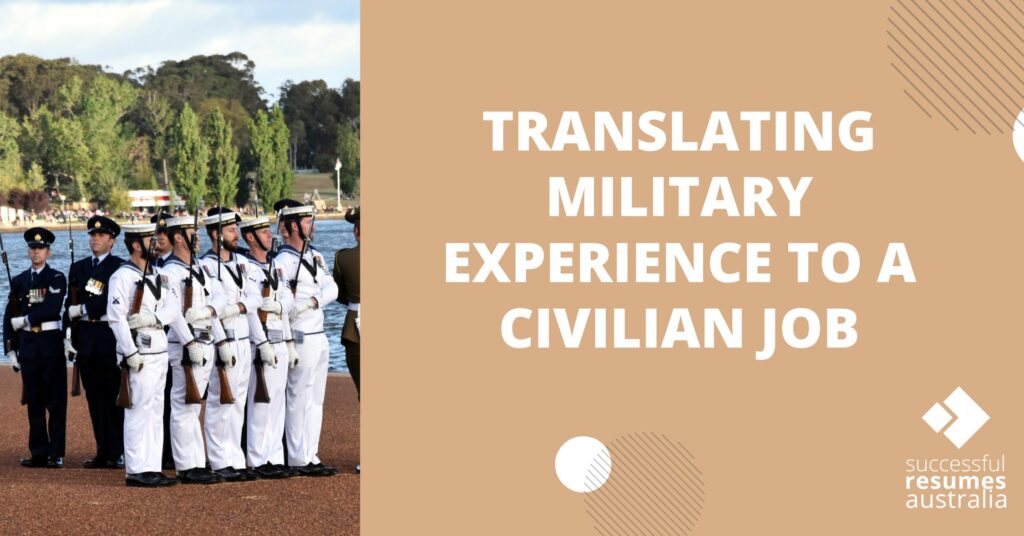
Many ex-military staff find it challenging to translate military experience into the civilian employment arena. If this is you, you might already know that it can be hard to know where to start, what to include on your resume and how to explain your military experience in civilian terms. Like all big changes, it can happen much smoother with preparation. Let’s take a look at some tips on making this transition. Create a transition planThe military has unique cultures so it’s not uncommon for discharged members to experience ‘culture shock’ when adjusting to civilian life and civilian workplaces. There are quite a few services and resources to support the transition including Open Arms. These services offer confidential one-on-one counselling to talk through any issues you or your family may be dealing with. This can help keep your mindset open to opportunity and your new chapter. Veterans looking to explore a career in tech could consider WithYouWithMe. This site also has a range of career assessment tools including aptitude and behavioural tests that can help you understand your potential careers in the civilian workforce. The Veteran Employment Toolkit is also a practical guide to planning your transition to the civilian workforce and is recommended by many veterans. Identify the job you’re seekingOnce you have an idea of the types of roles you are looking for, you can focus on bridging the gap between the skills and experience you already have, and those needed for the type of job that you want. You might need to complete a course or gain on the job experience to fill these gaps. Once you’ve decided on your desired job, you can then work backwards to identify the path to upskilling for your chosen job. Assess your transferable skillsFinding employment outside the ADF isn’t easy but understanding your skills is the first step in finding work that aligns with your post-transition employment goals. Ex-military staff sometimes sell themselves short and take whichever job they can get because they don’t realise how valuable their skill set is and how employable they are. For example, perhaps you managed or worked with a team, made on the fly and fast decisions, coordinated actions in high-stress environments or even thrived in ever-changing and chaotic environments. There are multiple soft skills in these examples. It’s just about taking the time to think about your experience and translate it to civilian life. You’ll be surprised at the number of skills you have! Some examples of transferable skills between military and civilian life include: Problem-solving Collaboration Critical thinkingResponsiveness Leadership Technology SkillsProject management Teamwork OrganisationAttention to detail Strong work ethic Technical writingManaging logistics and resources Understanding compliance, SoP’s and technical frameworks Self-sufficiency Australia’s military is one of the most highly skilled in the world. It’s likely you have qualifications, training, skills and experience that will make you a valuable member of the civilian workforce. Don’t underestimate the professional learning and development you have gained from your service. Identify and build networksNetworks are a great way to find new opportunities. In fact, a high percentage of jobs are still never advertised because they are able to fill the positions within their networks. Connect with ex-colleagues, family and friends and let them know you’re looking to transition back so they can keep their eye out for roles that might suit. You can also build your network by meeting people through others including ex-service organisations, sporting or other interest groups, and/or through social media. Great networks not only help to open up job opportunities, they also create a solid support structure and help you feel more connected in civilian life. Adjust your language to your new audienceYou’ve probably spent years speaking with particular terminology and phrases relevant to the military but in order to adjust to civilian life as an employee, you’ll need to focus on changing your language to match the way people speak in the type of job that you’re pitching for. Avoid using acronyms and make sure you translate any jargon into language that employers can understand. Employ a professional resume writerHiring a professional resume writer can take the stress out of the job search. The process also helps build confidence and gets you started on the right foot. Phil Mitchell, based on the NSW/VIC border, is particularly experienced in supporting veterans transition to civvy life. He works with clients one-on-one to help you create the perfect resume that combines your military experience with your relevant skills. Phil will also help you to explain your skillset in non-military terms. Obviously, you’re the expert when it comes to your military experience and similarly, it’s critical to employ an expert when it comes to marketing yourself for employment opportunities. As well as producing an outstanding resume, they can also assist you with publishing a LinkedIn profile and writing tailored cover letters for your job applications. It’ll be money well spent because selling yourself in the best possible light is necessary for your success. Please contact us today to help you get started in cracking the civilian employment market.
Mature Age Workers: Unlocking Opportunities for Job Seekers and Employers in Australia

Written by: Louise De Chiera, Successful Resumes South West Western Australia Are you wondering what it means to be a mature age worker? As I sit here contemplating this question, I find myself in my mid-40s, reflecting on my own professional journey. Despite having worked for myself over the past seven years, I can’t help but acknowledge that I may fall into the mature age bracket. If I were to enter the labour market and apply for a new position, I would likely be considered a mature age candidate, competing against individuals from various age groups. According to the Department of Employment and Workplace Relations, mature age workers are generally classified as individuals over the age of 45. This means that you may spend a significant portion of your working life, approximately twenty-two years, as a mature age worker until retirement at 67. That’s not even taking into consideration that an increasing number of people are choosing to work well beyond the age of 67, extending their careers into their 70s. If you are a mature age worker contemplating a job change or considering a career transition, it’s essential not to let age become a barrier. There is growing recognition of the value that mature age workers bring to organisations, prompting business owners, HR professionals, and recruiters to reconsider their perceptions. As a young twenty-year-old starting my career, I learned invaluable skills from colleagues aged over 45. I am grateful for the knowledge and experience they passed on. As a mature age worker, you possess life experience and a diverse range of skills that can greatly contribute to a business. Employing mature age workers offers numerous benefits: When applying for positions as a mature age worker, it’s important to communicate these advantages to prospective employers. How to avoid age bias Discrimination based on age, whether it’s favouring younger candidates or overlooking the skills and experience of mature age workers, can limit opportunities in the job market. Here are some simple tips to help avoid age bias during the recruitment process, consider the following tips: Reach out for support Jobs and SkillsWA offers support programs for mature age workers re-entering the workforce, including Skills Checkpoint, Skills and Training Incentives, and Work Bonuses that allow you to earn additional income without affecting pension payments. At Successful Resumes, we understand the unique experiences and challenges faced by mature age workers. Our team of writers, most of whom fall into this category, can relate to your situation. Contact any of our writers today to help identify your skills and tailor a compelling resume and cover letter for your next application. Ultimately, the mature age workforce presents a distinctive opportunity for both job seekers and employers in Australia. Excerpt: Are you a mature age worker considering a job change or career transition? Don’t let age be a barrier to your success! Discover the benefits of employing mature age workers and how to avoid age bias during the recruitment process. At Successful Resumes, we understand your unique experiences and challenges, and our expert writers can tailor a compelling resume and cover letter to showcase your skills. Take advantage of the distinctive opportunities in the mature age workforce. Contact us today!
Why you shouldn’t create a resume using ChatGPT
ChatGPT took the world by storm in late 2022. The chatbot created by open.ai quickly went viral on social media with users showing the enormous capability of the platform. Next you know, we’re all using the tool to help with travel planning, writing code, creating content, and even writing resumes. It’s no surprise people are attracted to using automated tools to create their resumes. It’s fast, easy and on the surface, looks like a solid option to speed up job search success. But while it might seem low-cost, convenient and time-saving, there are drawbacks to relying solely on generative AI to tell your career story. Let’s delve into the reasons why you should think twice before using generative AI to write your resume. Lack of Personalisation One of the major drawbacks of generative AI is its tendency to produce generic content. Resumes crafted by AI algorithms lack a personal touch and uniqueness that can make you stand out from other candidates. Since the AI system generates templates based on pre-existing data, there is a high probability of sounding just like countless other applicants, diluting your individuality and making it harder for employers to put you in the ‘interview’ pile. Unintentional Mistakes and Misrepresentations AI like ChatGPT relies on vast datasets to create content, but it can’t accurately capture the nuances and intricacies of your professional experiences and achievements. AI algorithms can inadvertently produce incorrect or misleading information in your resume, leading to potential misunderstandings during the hiring process. Trusting AI blindly may result in misrepresenting your skills, qualifications, or work history, which can seriously harm your credibility. Limited Contextual Understanding Resumes are not just about listing your skills and experiences; they are an opportunity to tell your story and demonstrate why you are the right fit for a particular role. Generative AI algorithms lack contextual understanding and are not able to grasp the specific requirements of the job you’re applying for. This limitation can lead to irrelevant information or the omission of crucial details that would have otherwise highlighted your suitability for the position. The key to a fantastic resume is making it relevant and meaningful to the reader. The document should present you as the solution to their need by tying the role requirements to your capability. Inability to Reflect Your Voice and Style Your resume is a reflection of your personal brand and professional identity. It should authentically represent your voice, values, and unique attributes. At least for now, generative AI can’t capture your individual writing style, tone, or personality. Relying solely on AI-generated content is more than likely going to give you a resume that feels impersonal and detached, lacking the essence of who you are as a professional. Worst case scenario, it looks and sounds a lot like other resumes they have received, also written by AI. Human Touch and Expertise Resume writing requires a human touch. A skilled professional resume writer will provide you with new insights into your unique strengths and capabilities and tailor your resume while understanding the intricacies of the job market. Professional resume writers possess the knowledge and experience to optimise your resume for specific roles, highlight your strengths, and craft compelling narratives that resonate with potential employers. Their expertise ensures that your resume is tailored to your unique background, showcases your accomplishments effectively, and maximises your chances of standing out. While generative AI has its advantages in various domains, relying solely on it to create your resume can be a gamble. The lack of personalisation, potential for mistakes or misrepresentations, limited contextual understanding, inability to reflect your voice, and the absence of human expertise are compelling reasons to opt for a more personalised and human-centric approach when it comes to crafting your resume. To make a lasting impression on employers and increase your chances of securing interviews, consider seeking the assistance of a professional resume writer who will draw out your unique strengths and capabilities to create a tailored and impactful resume that truly represents who you are as a candidate. Investing in a professionally written resume will ensure that you present yourself in the best possible light and enhance your prospects in today’s competitive job market.
What to do when you’ve lost interest in your job

We all have days where we feel like we’re just going through the motions at work. But when those days turn into weeks or even months, and you find yourself dreading going to work each day, it might be a sign that you’ve lost interest in your job. This can be a difficult and frustrating situation to be in, but there are steps you can take to regain your motivation and find fulfilment in your career again! Identify the source of your disinterest The first step in addressing your disinterest in your job is to identify the source of the problem. Ask yourself: What specifically is causing me to feel unmotivated at work? Is it a lack of challenge or growth opportunities? Is it a difficult relationship with a co-worker or manager? Is it a misalignment between your values and the company’s mission? Identifying the root cause will help you determine what steps you need to take to address the issue. Challenge your thinking to change how you feel. Before taking bigger steps to solve the problem, first test if reframing can help change the way you’re feeling. One of the best ways to get excited about your work is by focusing on what you like about it. Focusing on the positives can be a powerful tool to help you regain interest. One way to do this is by making a list of all the things you like about your job. This could include things like: Once you have your list, take some time to reflect on each item and think about how it makes you feel. Try to focus on the emotions that each positive aspect of your job evokes. For example, if you love that you get paid well for your work, think about how that makes you feel. Perhaps it gives you a sense of security or allows you to feel more financially stable. Talk to your manager Once you’ve identified the source of your disinterest, it’s important to communicate your concerns with your manager. This can be a difficult conversation to have, but the more open and communicative you can be the more likely you will be able to work with your manager to come up with solutions that work for everyone. Be honest and specific about what’s causing your disinterest and what you would like to see changed. Talk to your boss about any opportunities for growth or development within the company, and don’t be afraid to ask for new challenges. Find ways to reignite your passion If your manager is unable to offer a solution that meets your needs, or if you’re not ready to leave your job just yet, it’s important to find ways to reignite your passion for your work. Look for new challenges or projects within your current role that you find interesting. This can help you see your job in a new light and regain your motivation. Alternatively, consider taking on new responsibilities or volunteering for projects outside of your job that align with your interests. Invest in your professional development Another way to regain your motivation and interest in your job is to invest in your professional development. This can include attending conferences or workshops, taking courses, or working with a mentor or coach. Not only will this help you develop new skills and knowledge, but it can also provide new perspectives and insights into your job. Consider career counselling Seeking support from a career counsellor or coach can be a great way to explore your interests and identify new career paths that align with your passions and goals. A career counsellor can help you envision success. What would your ideal job look like? How would you feel if you had the perfect career? Getting clarity on your skills, interests and passions can help you feel inspired and enthusiastic about your future next steps. Consider a career change If you’ve tried all of the above steps and still find yourself disinterested in your job, it may be time to consider a career change. This can be a difficult decision to make, but it’s important to remember that it’s never too late to pursue a career that aligns with your interests and passions. Take the time to research new industries and positions that interest you, and reach out to your network for advice and connections. Losing interest in your job can happen to anyone. However, by focusing on the positives, reframing your mindset, taking on new challenges, and seeking support, you can regain your enthusiasm and find joy in your work again. Reach out to the team at Successful Resumes Australia to see how we can support you find a career you love.